

If your hairbrush is collecting more strands than usual, smoking might be part of the problem. It’s not just your lungs, heart, and skin that take a hit from cigarettes — your hair follicles absorb the damage too.
The short answer: yes, smoking can cause hair loss. Multiple studies now link tobacco use to thinning hair, early-onset baldness, and premature graying in both men and women. But the “why” behind it is more interesting than most people realize, and it changes how you should think about treatment.
In this guide, you’ll learn exactly how cigarettes damage your hair follicles, what the research actually says, whether vaping is any safer, and what you can do about it — including options like scalp micropigmentation, low-level laser therapy, and hair transplants.
Does Smoking Cause Hair Loss? What the Science Says
Yes — and the connection isn’t just anecdotal. Several peer-reviewed studies have found that smokers are significantly more likely to experience moderate to severe hair loss than non-smokers.
Here’s what the research shows:
- One widely cited study of Taiwanese men found that people who smoked more than 20 cigarettes a day were twice as likely to develop moderate or severe hair loss compared to non-smokers.
- Men with a genetic predisposition to male pattern baldness who also smoked heavily were found to be up to 13 times more likely to lose their hair.
- A separate study comparing 500 smokers to 500 non-smokers found that 85% of smokers showed some degree of hair loss, versus only 40% of non-smokers.
- Former smokers who had quit showed a reduced risk, suggesting the damage isn’t necessarily permanent once you stop.
A 2003 review published on smoking and hair loss described the process as “multifactorial,” pointing to damaged blood vessels around the hair follicle, DNA damage from toxic chemicals, and hormone disruption as the key drivers.
In plain terms: cigarette smoke doesn’t just affect your lungs. It travels through your bloodstream and directly interferes with the tiny structures that grow your hair.
How Smoking Damages Your Hair Follicles

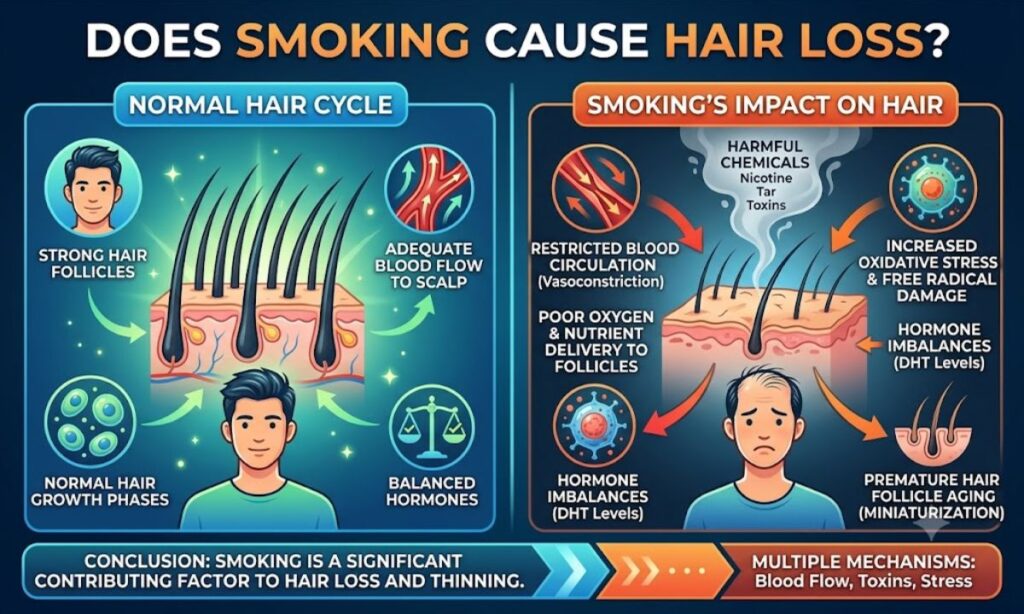
Smoking doesn’t cause hair loss through one single mechanism — it attacks your hair from several angles at once. Here’s a breakdown of the main pathways.
1. Restricted Blood Flow to the Scalp
Hair follicles need a steady supply of oxygen and nutrients to grow. Nicotine and carbon monoxide in cigarette smoke cause blood vessels to narrow (vasoconstriction), which reduces circulation to the scalp. Less blood flow means your follicles are essentially being starved.
2. Oxidative Stress and DNA Damage
Cigarette smoke dramatically increases free radicals in your body. These unstable molecules damage the DNA inside hair follicle cells, weakening the follicle’s ability to produce healthy hair. Over time, this oxidative stress can shrink follicles and shorten the hair growth cycle.
3. Chronic Inflammation
Smoking triggers the release of inflammatory proteins called cytokines. This can lead to scarring around the follicle, making hair more brittle and prone to falling out — a process linked to early-onset androgenetic alopecia (male and female pattern baldness).
4. Hormonal Disruption
In women, smoking has been associated with lower estrogen levels. Since estrogen plays a protective role in hair growth, a drop in this hormone can accelerate thinning, especially around menopause.
5. A Weakened Immune System and Dry Scalp
Smoking dries out skin, including the scalp. A dry, irritated scalp is more prone to dandruff and infection, creating a poor environment for hair to grow. Smoking also weakens your body’s natural healing response, so any scalp irritation takes longer to resolve.
Does Vaping Cause Hair Loss Too?

This is one of the most common questions people ask once they’ve switched from cigarettes to vaping, hoping it’s the safer option for their hair.
Unfortunately, early research suggests vaping isn’t off the hook. A 2018 report found notable evidence that vaping can cause oxidative stress and DNA damage — the same mechanisms linked to smoking-related hair loss. Nicotine, whether inhaled from a cigarette or a vape pen, still narrows blood vessels and disrupts the hair growth cycle.
That said, research on vaping specifically is newer and less extensive than smoking research. The consensus among dermatologists right now is: vaping likely carries a lower risk than cigarettes, but it’s not risk-free, especially for anyone already genetically prone to hair loss.
Smoking and Hair Loss in Men vs. Women
Hair loss patterns differ between men and women, and smoking appears to affect each group somewhat differently.
| Factor | Men | Women |
| Common pattern | Frontal and vertex (crown) thinning | Diffuse thinning across the scalp |
| Genetic link | Strongly amplified by smoking if predisposed | Less studied, but present |
| Hormonal impact | Increased DHT sensitivity | Lowered estrogen levels |
| Onset | Can accelerate early-onset baldness | Linked to earlier menopause-related thinning |
| Reversibility after quitting | Partial, depends on genetics | Partial, depends on hormone recovery |
The takeaway: smoking doesn’t create hair loss out of nowhere — it accelerates and worsens a process that’s often already influenced by genetics. If you’re not genetically predisposed to baldness, smoking-related thinning may be milder and more reversible.
All Also Read This On Does Smoking Cause Hair Loss
Separating Fact From Myth: Is “Smoking Hair Loss” Overblown?

It’s worth addressing the skepticism you’ll find in forums and online communities. Search around and you’ll see plenty of people asking “does smoking really cause hair loss, or is this exaggerated?” on Reddit threads and Q&A sites like Quora.
Here’s the honest, balanced answer:
- It’s real, but not universal. Not every smoker will experience noticeable hair loss, and some studies found the smoking-hair loss link wasn’t statistically significant in every population studied.
- Genetics still play the biggest role. If male or female pattern baldness doesn’t run in your family, smoking is less likely to cause dramatic thinning on its own.
- It’s a compounding factor, not a standalone cause. Think of smoking as fuel on a fire that’s already burning slowly — it speeds up a process that may have happened anyway.
- The evidence has grown stronger over the last two decades. Early studies were smaller and less conclusive; newer systematic reviews present a much clearer picture linking smoking to accelerated hair thinning.
So the “smoking causes hair loss” idea isn’t a myth — but it’s also not a guarantee that every smoker will go bald. It’s a risk multiplier, not a certainty.
Other Lifestyle Factors That Compound Hair Loss
Smoking rarely acts alone. If you’re a smoker also dealing with other stressors, your hair loss risk climbs even higher. Common compounding factors include:
- Chronic stress — raises cortisol, which can push hair follicles into a resting (shedding) phase
- Poor diet — low iron, protein, or vitamin D can weaken hair growth
- Alcohol consumption — dehydrates the body and scalp, and can affect nutrient absorption
- Lack of sleep — disrupts the hormone balance needed for healthy hair cycles
- Sun and pollution exposure — adds to oxidative stress on the scalp
- Underlying health conditions — thyroid issues, PCOS, and autoimmune conditions can accelerate thinning independently of smoking
If you smoke and struggle with several of these at once, addressing smoking first often produces the most noticeable improvement in scalp health.
Can Quitting Smoking Reverse Hair Loss?
This is the question everyone really wants answered — and the honest response is: it depends.
- Circulation improves quickly. Within weeks to months of quitting, blood flow to your scalp begins to normalize.
- Follicle damage may be permanent in some cases. If a follicle has already scarred or been destroyed by long-term oxidative stress, it typically won’t produce hair again.
- Genetic hair loss won’t reverse on its own. If you have male or female pattern baldness, quitting smoking may slow further loss, but it won’t regrow hair that’s already gone.
- Non-genetic thinning has a better outlook. If your hair loss was mainly diet- or lifestyle-driven, quitting combined with better nutrition can lead to visible regrowth over 6–12 months.
Quitting is still worth it — even if it doesn’t fully reverse existing hair loss, it stops the damage from getting worse and improves your overall health.
Hair Loss Treatments After Smoking or Vaping
If you’ve already noticed thinning, there are several evidence-based options worth discussing with a specialist.
Scalp Micropigmentation (SMP)

SMP is a non-surgical treatment that uses tiny pigment deposits to mimic the look of hair follicles on the scalp. It’s a popular choice for people with significant thinning or receding hairlines who want an immediate, low-maintenance cosmetic result without surgery.
Low-Level Laser Therapy (LLLT)
LLLT uses red-light wavelengths to stimulate blood flow and energy production in hair follicle cells. It’s commonly used for early-stage thinning and works best when paired with lifestyle changes like quitting smoking.
Topical and Medical Treatments
Options like minoxidil and finasteride (for men) can help slow further loss and, in some cases, support regrowth — particularly when combined with improved circulation from quitting smoking.
Hair Transplant Surgery
For more advanced hair loss, a hair transplant relocates healthy, permanent follicles (usually from the back of the scalp) to thinning or bald areas. This is typically considered when other treatments haven’t produced enough improvement, or when hair loss has progressed significantly.
Do You Need a Hair Transplant?
Not everyone with thinning hair needs surgery. A transplant tends to make sense if:
- Hair loss has progressed past early-stage thinning
- Non-surgical treatments (LLLT, topicals) haven’t slowed the loss
- You want a long-term, permanent solution rather than ongoing maintenance
- A specialist confirms you have enough healthy donor hair for transplantation
The best way to know for sure is a professional consultation, where a specialist can assess your hair loss pattern, donor hair supply, and realistic outcomes.
Book Your Hair Consultation with Darling Downs Hair Transplant Clinic
If smoking, vaping, or genetics have taken a toll on your hair, you don’t have to figure out the right next step alone. Darling Downs Hair Transplant Clinic offers personalized consultations to assess your hair loss, explain which treatment options suit your situation, and help you make an informed decision — whether that’s SMP, LLLT, or a hair transplant.
Conclusion
So, does smoking cause hair loss? The evidence says yes. Cigarettes damage blood flow, cause inflammation, and stress your hair follicles. Over time, this can lead to thinning and early baldness.
But smoking isn’t the only factor at play. Genetics still decide a lot of what happens to your hair. Smoking just speeds things up and makes existing problems worse.
The good news is quitting helps. Your circulation improves within weeks. Combined with the right treatment, you can protect the hair you still have.
Frequently Asked Questions
Can smoking make your hair fall out?
Yes. Smoking damages hair follicles by reducing blood flow and increasing inflammation, which can lead to hair falling out over time.
How long does it take for smoking to cause hair loss?
It varies by person, but noticeable thinning can develop after months to years of regular smoking, especially in those genetically prone to hair loss.
Does quitting smoking stop hair loss?
Quitting can slow further damage and improve scalp circulation, but it may not regrow hair that’s already been lost.
Is hair loss from smoking permanent?
It depends. If follicles are scarred or destroyed, the loss is usually permanent. Early-stage thinning has a better chance of improving after quitting.
Does smoking cause hair loss in women?
Yes. Smoking is linked to lower estrogen levels in women, which can speed up thinning, especially around menopause.
What does smoking do to your hair follicles?
Smoking narrows blood vessels, increases free radicals, and triggers inflammation, all of which weaken hair follicles and slow healthy hair growth.
Can vaping cause hair loss like smoking does?
Possibly. Vaping still exposes hair follicles to nicotine and oxidative stress, though research on its effects is still more limited than smoking studies.
