

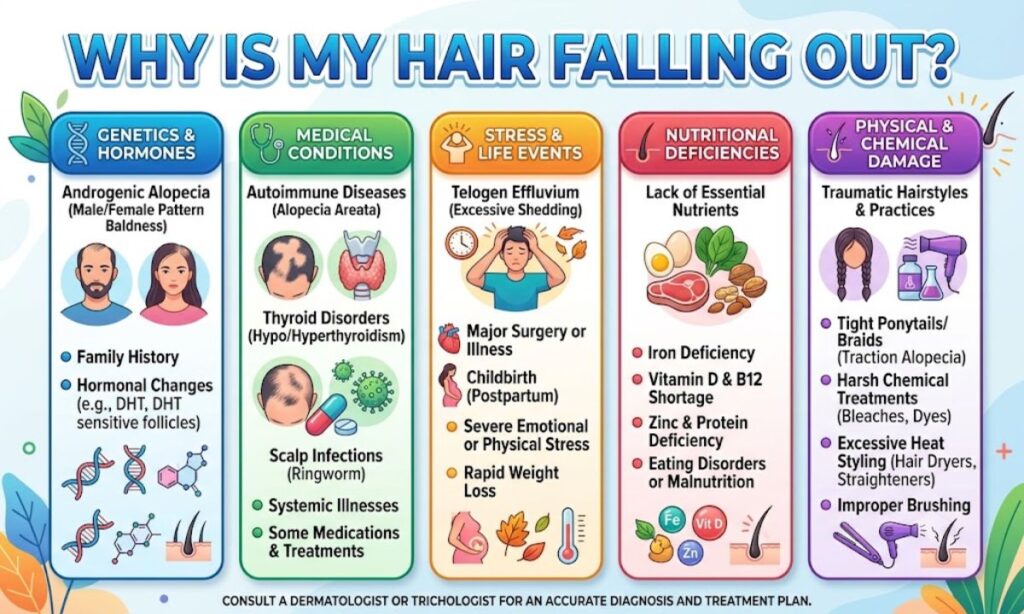
Finding extra strands on your pillow, in the shower drain, or tangled in your hairbrush can be unsettling. Most people ask the same question the moment they notice it: why is my hair falling out?
The honest answer is that it depends. Some hair fall is completely normal. Some points to a temporary stressor your body is recovering from. And some signals a longer-term condition that needs medical attention.
This guide breaks down the real causes of hair shedding, how to tell normal loss from a problem, and what actually works to slow it down — without the fluff or scare tactics you’ll find elsewhere.
Is Hair Shedding Always a Sign of Hair Loss?

No. Shedding and hair loss are not the same thing, and mixing them up is where most of the panic starts.
Normal shedding happens because every hair follicle cycles through growth, rest, and release phases on its own timeline. Losing somewhere between 50 and 100 hairs a day is considered typical for most people. Since new hairs are constantly growing in to replace them, your overall density stays the same.
Hair loss, on the other hand, means the follicle either stops producing new hair or produces something finer and weaker than before. Over time, this shows up as visible thinning, a widening part, or bald patches.
Here’s a simple way to compare the two:
| Feature | Normal Shedding | Actual Hair Loss |
| Daily hair count | 50–100 strands | Often 150+ strands |
| Regrowth | New hair replaces shed hair | Follicles slow down or stop |
| Scalp appearance | No visible change | Thinning, widening part, bald spots |
| Duration | Ongoing, stable pattern | Progressive or sudden onset |
| Common trigger | Natural hair cycle | Illness, hormones, genetics, stress |
If you’re pulling more hair than usual out of your brush for several weeks in a row, or you can see your scalp more clearly than before, it’s worth digging into the underlying cause.
Why Is My Hair Falling Out So Much?

Excessive shedding usually has an identifiable trigger. Here are the most common ones dermatologists point to.
1. Telogen Effluvium (Stress-Related Shedding)
This is the single most common reason people suddenly notice handfuls of hair coming out. It happens when a large percentage of hair follicles get pushed into the resting (telogen) phase all at once, usually two to three months after a triggering event such as:
- A high fever or infection
- Major surgery or physical trauma
- Rapid weight loss or crash dieting
- Childbirth
- Severe emotional stress
- Stopping or starting certain medications
The good news: telogen effluvium is usually temporary, and hair typically regrows once the trigger resolves.
2. Androgenetic Alopecia (Genetic Pattern Hair Loss)
Known as male pattern baldness or female pattern hair loss, this is driven by genetics and hormone sensitivity in the follicles. Unlike telogen effluvium, it’s gradual and progressive rather than sudden, showing up as a receding hairline, crown thinning, or an overall widening part.
3. Alopecia Areata (Autoimmune Hair Loss)
This condition causes the immune system to mistakenly attack hair follicles, often resulting in sudden, coin-sized bald patches. It can affect the scalp, eyebrows, or eyelashes and may come and go unpredictably.
4. Thyroid Imbalance
Both an underactive and overactive thyroid can disrupt the hair growth cycle. Hormone imbalances here often lead to diffuse thinning across the whole scalp rather than in one specific spot.
5. Nutritional Deficiencies
Your hair follicles are not essential for survival, so when your body is short on key nutrients, it prioritizes vital organs first. This can quietly starve your hair of what it needs to grow.
6. Hairstyling and Traction Damage
Tight ponytails, braids, extensions, and frequent heat or chemical treatments can physically stress the follicle. Left unchecked, this can lead to traction alopecia, which becomes harder to reverse the longer it continues.
7. Medications
Certain drugs — including blood thinners, some blood pressure medications, antidepressants, and retinoids — list hair thinning as a known side effect.
All Also Read Hair On Hair Falling Out
Why Is My Hair Falling Out Female?
Hair loss in women often gets overlooked because it doesn’t always follow the classic “bald spot” pattern seen in men. Instead, it tends to show up as:
- Overall thinning across the top of the scalp
- A part that looks noticeably wider than before
- Ponytails that feel thinner in your hand
- Increased hair visible on pillows, in the shower, and on brushes
Common female-specific triggers include:
- Postpartum hair loss — driven by the sharp estrogen drop after childbirth, typically peaking around three months postpartum and resolving within a year
- Menopause — hormonal shifts can trigger both shedding and thinning
- PCOS — hormonal imbalance linked to excess androgens can cause pattern-style thinning
- Iron-deficiency anemia — one of the most common nutritional causes of hair fall in women
- Tight hairstyles — buns, braids, and extensions worn consistently over years
If your hair loss appears alongside irregular periods, fatigue, or unexplained weight changes, it’s worth getting hormone and thyroid levels checked rather than guessing.
Why Is My Hair Falling Out Suddenly?
Sudden, dramatic shedding is almost always your body’s reaction to a specific event that happened weeks or months earlier — not something happening right now. Common culprits include:
- A recent illness, infection, or high fever
- A major surgery or hospital stay
- An extreme diet or sudden weight loss
- A new medication or supplement
- A significant emotional shock (loss, divorce, financial stress)
- Discontinuing hormonal birth control
Because telogen effluvium has a built-in delay, people are often confused about the cause — the real trigger usually happened two to three months before the shedding started.
How to Stop Hair Fall Immediately

While there’s no magic switch that stops shedding overnight, these steps genuinely help reduce hair fall and support faster recovery:
- Be gentle with wet hair. Hair is weakest when wet, so avoid vigorous towel-drying or brushing right after a shower.
- Switch to a wide-tooth comb. This reduces breakage compared to fine-toothed brushes.
- Loosen your hairstyles. Give your scalp a break from tight ponytails, buns, and extensions.
- Reduce heat styling. Blow-dryers, straighteners, and curling irons weaken the hair shaft over time.
- Check your protein and iron intake. Both are building blocks for healthy hair growth.
- Manage stress. Techniques like exercise, sleep hygiene, and mindfulness can help regulate the hormones tied to shedding.
- Consider topical minoxidil. This is one of the few over-the-counter treatments with solid clinical backing for regrowth, though it typically takes 3–6 months to show results.
- See a dermatologist for persistent cases. If shedding continues beyond a few months, blood work can rule out thyroid, iron, or autoimmune causes.
Which Vitamin Deficiency Causes Hair Loss?
Several nutrient gaps are strongly linked to hair shedding and thinning. Here’s a quick reference:
| Vitamin/Mineral | Role in Hair Health | Who’s Commonly Affected |
| Iron | Carries oxygen to hair follicles via hemoglobin | Women with heavy periods, vegetarians |
| Vitamin D | Activates hair follicle stem cells for growth phase | People with limited sun exposure |
| Vitamin B12 | Supports red blood cell production and oxygen delivery | Vegans, vegetarians, older adults |
| Biotin (B7) | Supports keratin production | Rare, but linked to brittle hair when deficient |
| Zinc | Supports follicle repair and oil gland function | Restrictive diets, digestive disorders |
| Vitamin A | Regulates scalp sebum production | Both deficiency and excess can cause shedding |
A key sign of nutrient-related hair loss is that it tends to be diffuse — spread evenly across the scalp — rather than patchy or localized like autoimmune or traction-related hair loss. A simple blood test can confirm whether a deficiency is contributing to your shedding, and correcting it often reverses the hair loss within a few months.
When to See a Doctor

Self-care steps help with mild shedding, but book an appointment with a dermatologist if you notice:
- Bald patches, especially with a smooth, shiny scalp
- Hair loss combined with itching, redness, or scaling
- Sudden loss of large clumps of hair
- Thinning alongside other symptoms like fatigue, weight changes, or irregular periods
- No improvement after 3–6 months of home care
A professional can run bloodwork, examine your scalp, and recommend targeted treatments like minoxidil, corticosteroids, or hormone therapy depending on the underlying cause.
Why Is My Hair Falling Out? Shower, Clumps, and Teen Hair Loss Explained
Making Sense of Sudden Shedding and Thinning

You wash your hair, glance down at the drain, and there it is — a clump of hair staring back at you. Or you’re a teenager watching your hairline in the mirror, wondering if something’s wrong. Either way, the question is the same: why is my hair falling out?
Here’s the reassuring part first: most hair fall — even the kind that looks dramatic in the shower — is completely normal. But there’s a line between routine shedding and a real problem, and knowing where that line sits is what actually matters.
This guide walks through the most common triggers, explains why washing and brushing seem to make things worse, and breaks down what’s different about hair loss during the teenage years.
Hair Shedding vs Hair Loss: Why the Difference Matters
These two terms get used interchangeably, but they describe very different situations.
Hair shedding is a built-in part of the hair growth cycle. Every strand grows for years, rests for a few months, then releases itself to make room for a new one. This happens continuously, all over your scalp, whether you notice it or not.
Hair loss happens when that cycle breaks down — follicles stop producing hair altogether, or they produce thinner, weaker strands than before. Unlike shedding, hair loss changes your overall density over time.
| Factor | Hair Shedding | Hair Loss |
| Daily amount | 50–100 strands | Often noticeably higher |
| Follicle activity | Working normally | Slowed, damaged, or dormant |
| Regrowth | New hair replaces old hair | Little to no replacement |
| Scalp appearance | Unchanged | Widening part, visible scalp, patches |
| Where it’s noticed | Shower, brush, pillow | Same places, but with visible thinning too |
Knowing this difference stops you from panicking over a normal shower drain, while still taking real warning signs seriously.
Why Is My Hair Falling Out When I Wash It?
Washing puts more physical stress on your hair than almost anything else you do to it, which is exactly why shower shedding feels so noticeable.
Here’s what’s actually happening:
- Wet hair clumps together. Loose strands that would fall out gradually over the day instead detach all at once and stick to each other, making the amount look bigger than it is.
- Massaging the scalp dislodges resting hairs. Any hair already in its shedding phase gets released the moment you shampoo and rub your scalp.
- Hot water strips natural oils. This dries out both scalp and strands, weakening hair over time and making it more prone to breakage.
- Infrequent washing hides shedding, then releases it all at once. If you only wash once or twice a week, hair that would have shed gradually builds up and comes out in a bigger batch.
- Harsh shampoos and sulfates can strip protective oils, leaving hair more fragile during washing.
In short: you’re not losing more hair because you washed it — you’re just seeing hair that was already ready to fall out.
Why Is My Hair Falling Out in the Shower?

This is essentially the same phenomenon as above, but worth addressing directly because it’s often the most alarming moment of the day.
What’s normal:
- 50–100 strands lost daily, with a good portion released during washing
- Slightly more shedding if you have long or thick hair, simply because there’s more of it
- More visible hair on your hands or in the drain than you’d expect, purely due to wet clumping
What’s worth watching:
- Losing noticeably large clumps rather than individual strands
- Hair coming out from one specific area of the scalp repeatedly
- A bald patch appearing within a day or two
- Shedding that’s paired with scalp itching, redness, or flaking
If it’s the first list, a few simple habits go a long way:
- Use lukewarm, not hot, water
- Choose a gentle, sulfate-free shampoo
- Avoid vigorous scrubbing — massage gently instead
- Detangle with a wide-tooth comb, working from ends to roots
- Skip tight ponytails and rubber bands immediately after washing, when hair is weakest
Why Is My Hair Falling Out in Clumps?

Losing single strands is one thing. Losing visible clumps is a different signal entirely, and it usually points to one of these causes:
Telogen Effluvium
A large batch of follicles gets pushed into the shedding phase simultaneously, usually triggered by illness, major stress, surgery, or rapid weight loss two to three months earlier. It presents as diffuse, all-over shedding rather than one bald spot.
Alopecia Areata
An autoimmune condition where the immune system attacks hair follicles directly, often causing sudden, coin-shaped bald patches. This can strike without warning and may affect eyebrows or eyelashes too.
Traction Alopecia
Caused by constant pulling from tight ponytails, braids, or extensions. Clumps often come out from the same stressed area — usually the hairline or temples.
Chemical or Heat Damage
Overuse of dyes, relaxers, or heat styling tools can weaken the hair shaft so much that it snaps off in clumps rather than shedding naturally at the root.
Fungal Infections
Scalp infections like tinea capitis can cause patchy hair loss along with scaling, itching, or redness, and typically require medical treatment.
When clumps appear, it’s worth seeing a dermatologist rather than waiting it out, especially if you notice scalp changes alongside it.
Causes, Treatments
Why Hair Loss Can Feel More Severe Than It Is

Hair loss has a way of feeling much bigger than it actually is, for a few very human reasons:
- You know your own hair intimately. A change that’s invisible to everyone else can feel obvious to you because you see your scalp and hairline every single day.
- Wet hair distorts perception. Clumped, wet strands in a drain look like far more hair than the same amount would look like dry.
- Anxiety creates a feedback loop. Stress itself is a known trigger for telogen effluvium, meaning worrying about hair loss can genuinely make it worse.
- Comparison amplifies concern. Scrolling through images of thick, styled hair online can make normal density look inadequate by comparison.
This doesn’t mean your concern isn’t valid — it means it’s worth grounding your worry in facts (how much you’re actually losing, whether density is truly changing) rather than in how alarming it feels in the moment.
Why Is My Hair Falling Out as a Teenager?
Hair loss isn’t reserved for adults. It shows up in teens more often than most people realize, and the causes are a little different from what affects older adults.
Common Reasons for Hair Falling Out in Teens
| Cause | How It Shows Up |
| Puberty hormone shifts | Diffuse thinning in both boys and girls |
| Androgenetic alopecia | Receding hairline (boys), widening part (girls); often runs in families |
| Stress and academic pressure | Sudden shedding two to three months after a stressful period |
| Nutritional deficiencies | Weak, brittle hair from low iron, zinc, biotin, or vitamin D |
| Restrictive dieting | Diffuse shedding tied to inadequate calorie or protein intake |
| PCOS (in teen girls) | Thinning combined with irregular periods and acne |
| Tight hairstyles | Thinning specifically at the hairline or temples |
| Trichotillomania | Patchy hair loss from habitual hair-pulling |
The good news is that many of these causes — nutrition, stress, and styling habits — are fully within a teen’s control to address. Genetic and hormonal causes may need a dermatologist’s input, but early evaluation tends to lead to better outcomes.
When Should You Be Concerned About Hair Loss?

Most shedding resolves on its own, but certain signs deserve a proper medical evaluation:
- Bald patches, especially with smooth or shiny skin visible
- Hair loss paired with itching, pain, redness, or scaling
- A widening part or visibly thinning crown that’s getting worse over months
- Sudden, large clumps coming out within a day or two
- Hair loss accompanied by fatigue, weight changes, or irregular periods
- No improvement after several months of gentler hair care and better nutrition
A dermatologist can run bloodwork to check iron, thyroid, and vitamin D levels, examine the scalp directly, and recommend treatments such as topical minoxidil, corticosteroid injections, or targeted supplements depending on the cause.
Conclusion
Hair loss can feel scary at first. But most shedding is just your body’s normal cycle. A little knowledge goes a long way toward calming your worries.
Not every cause needs medical help. Stress, diet, and hairstyles are easy to fix. Genetics and health conditions may need a doctor’s care.
The best step is simple. Watch your hair, care for it gently, and act early. Small changes today can protect your hair for years to come.
Frequently Asked Questions
Why is my hair falling out so much?
Most hair fall is caused by stress, poor diet, hormones, or genetics. Heavy shedding usually points to telogen effluvium, a temporary condition.
Why is my hair falling out all of a sudden?
Sudden hair loss often follows illness, stress, or a major body change weeks earlier. It’s usually temporary and grows back on its own.
What stops hair from falling out?
Gentle hair care, a balanced diet, and less heat styling help the most. Stress management also plays a big role in reducing shedding.
What vitamin deficiency causes hair loss?
Low iron, vitamin D, biotin, and B12 are common causes. A simple blood test can confirm which one is affecting you.
Is hair fall normal every day?
Yes. Losing 50 to 100 hairs a day is completely normal. New hair usually grows back to replace it.
How can I regrow my hair naturally?
Eating enough protein, iron, and vitamins supports regrowth. Reducing stress and gentle hair care also help hair grow back.
When should I worry about hair loss?
See a doctor if you notice bald patches, itching, or rapid thinning. Sudden clumps or scalp changes also need medical attention.
