
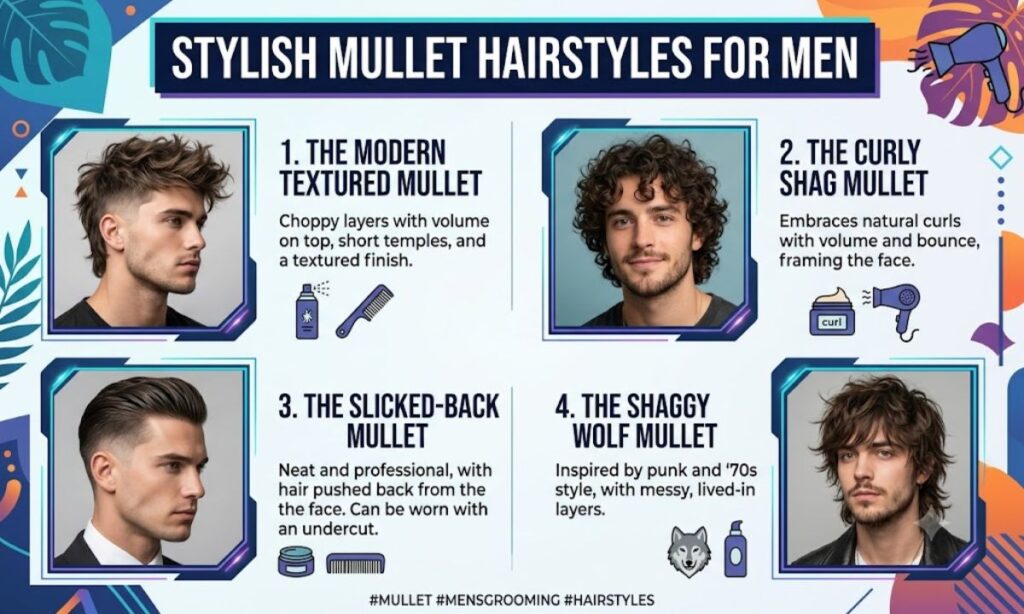
The mullet is no longer a punchline from an old family photo album. It has quietly become one of the most requested cuts in barbershops, and 2026 is shaping up to be the year it fully sheds its retro-joke reputation.
Short and structured on top, longer and looser at the back — the modern mullet blends the rebellious spirit of the original with the clean fades and texture work of today’s barbering.
If you’re thinking about making the switch, this guide breaks down what actually defines a mullet, why it’s trending again, and ten stylish variations worth showing your barber — from subtle office-friendly tapers to bold, statement-making cuts.
What Are The Male Mullet’s Hair Characteristics?
Before picking a version, it helps to know what actually makes a mullet a mullet. Strip away the styling and product, and every variation shares a few core traits:
- Short to medium length on top and sides — often faded, tapered, or cropped for contrast
- Noticeably longer hair at the back and nape — the signature “tail” that gives the cut its shape
- A clear length contrast between the front and back sections, rather than one continuous length
- Layered structure that allows movement, volume, and texture instead of a flat, blunt cut
- Customizable blending — today’s barbers soften the transition instead of leaving a harsh line
This combination is what separates a modern mullet from the harsher, undifferentiated cut of the 1980s. The silhouette is the same idea, but the execution is far more deliberate.
10 Stylish Mullet Hairstyles for Men With Beard
A beard adds structure to the face and pairs naturally with the volume of a mullet. Here are ten variations worth considering, whether you want something office-appropriate or something that turns heads.
1. Classic Curtain Mullet
A middle-parted fringe at the front with longer layers flowing down the back. It works best on straight or slightly wavy hair and gives a soft, effortless look inspired by Korean and K-pop styling trends.
2. Messy Tapered Mullet With Fringe
Volume and movement up top, tapered sides, and the classic mullet tail trailing down the back. This is the go-to choice for a laid-back, edgy finish.
3. Low Taper Mullet
A subtle fade around the ears and neckline creates a clean finish without heavy contrast. It’s easy to maintain and suits both professional and casual settings.
4. Burst Fade Mullet
The fade curves around the ear rather than cutting straight across, giving a rounder, sharper contrast without going overboard.
5. Shaggy Mullet With Beard
Messy, textured layers on top flow naturally into a longer back section. Faded sides add sharp contrast, making this a favorite for confident, fashion-forward men.
6. Baby Mullet
A compact cut bridging a crop and a traditional mullet, with just one to two inches of extra length at the nape. It offers the mullet silhouette without a dramatic commitment.
7. Curly or Permed Mullet
Curls naturally add volume that straight hair can’t match, making this version stand out with texture alone — no heavy styling required.
8. Wolf Cut Mullet
Heavy layers, big volume, and a deliberately shaggy finish. It’s essentially a mullet with extra attitude, and it pairs especially well with a full beard.
9. Pompadour Mullet
A structured, voluminous top combined with the classic longer back. This version leans more polished and works well for men who want height and definition.
10. Korean Mullet
Soft layers, natural volume, and a lightweight finish that avoids heavy fades in favor of flow and movement — a subtler, low-maintenance take on the trend.
Modern Mullet: How It Differs From the Original

| Feature | 1980s Classic Mullet | Modern Mullet (2026) |
| Contrast between sections | Harsh, undifferentiated | Softly blended fade |
| Sides | Often plain, no fade | Low, mid, or high fade |
| Texture | Flat, minimal layering | Heavy layering and movement |
| Styling products | Rarely used | Clay, texture powder, sea salt spray |
| Face shape suitability | Limited | Works across most face shapes |
| Maintenance | Grow-and-ignore | Regular trims to maintain shape |
All Also Read This Hair On Stylish Mullet Hairstyles
Why the Mullet Hairstyle for Men Is Becoming a Trend
The mullet’s comeback isn’t random. A few clear factors are driving its popularity heading into 2026.
Celebrity Influence
High-profile actors and musicians have brought the cut back into the mainstream conversation. Style commentary in major fashion and entertainment outlets has reframed the mullet as an intentional, structured look rather than a retro throwback, which has pushed more men to ask their barbers for it directly.
Versatile & Customizable
One of the biggest reasons the mullet has stuck around is choice. You’re not locked into a single look:
- Sharp and clean for the office
- Textured and messy for weekends
- Curly, straight, faded, or tapered — the base shape adapts to almost any hair type
- Subtle “baby mullet” versions for men who want the trend without a dramatic change
Low Maintenance, High Impact
Compared to many trending men’s cuts, the mullet requires relatively little daily effort:
- A quick blow-dry with light texture product
- Occasional trims every 4–6 weeks to maintain the length difference
- Minimal styling for the back section, since the length does most of the work
This balance of a bold silhouette with an easy upkeep routine is exactly why barbers describe it as one of the most requested cuts on the floor right now.
Mullet Cut Hairstyle for Boys

The trend isn’t limited to grown men. Shorter, softer versions of the mullet — with less dramatic length contrast — have become popular for boys and younger guys who want a trendy look that’s still school-appropriate. These typically use:
- A shorter back section than adult versions
- Minimal fading for a softer transition
- Simple, low-maintenance styling with little to no product
How to Choose the Right Mullet for Your Face Shape
Not every mullet variation suits every face. A quick reference:
- Round faces — opt for higher contrast fades (burst fade, low taper) to add angles
- Square faces — soften the look with curtain fringes or curly textures
- Oval faces — most versions work well, including the classic curtain or shaggy mullet
- Long faces — a fuller top (pompadour or wolf cut mullet) balances the proportions
It Is A Confidence Statement: Top Mullet Hairstyles For Men

A mullet is not just a haircut. It’s a decision. Wearing one signals that you’re not chasing whatever look everyone else has this month — you’re comfortable enough to stand out. That’s exactly why this once-mocked cut has quietly rebuilt itself into one of the most requested styles in modern barbershops.
This guide walks through where the mullet came from, why it survives every style cycle, and ten variations worth trying right now — along with practical tips on volume, pairing it with the rest of your look, and finding a salon that gets the cut right without charging a fortune.
The Mullet Journey: From Retro To Runaway
The mullet’s story didn’t start as a trend — it started as a practical cut. Shorter hair up front kept it out of the eyes and off the collar at work, while the longer back section kept the neck warm. Somewhere along the way, musicians and athletes in the 1970s and 80s turned that practicality into a statement, and the “business up front, party in the back” reputation was born.
For a while, the mullet became a cultural punchline. But haircuts, like fashion, move in cycles. Barbers started reworking the shape with cleaner fades and deliberate layering instead of the old flat, undifferentiated cut. What used to be an accident of length became an intentional style choice.
Today’s mullet isn’t a throwback joke — it’s a deliberately shaped cut that borrows the silhouette of the original while using modern texture, fade techniques, and styling products to make it wearable in almost any setting.
Why It Never Fully Disappeared
A few reasons the mullet kept resurfacing over the decades:
- It photographs well, which matters more than ever in a social-media-driven style culture
- It works across straight, wavy, and curly hair types
- It’s easy to dress up or down depending on the occasion
- It gives barbers room to get creative with fades, layers, and texture
Top 10 Stylish Mullet Hairstyles For Men

Here are ten variations that show just how far the modern mullet has come from its retro roots.
1. Classic Curtain Mullet
A center-parted fringe up front with flowing length at the back. Best suited to straight or slightly wavy hair for a soft, natural finish.
2. Burst Fade Mullet
The fade wraps around the ear instead of running straight across, creating a rounder, sharper contrast between the sides and the back length.
3. Low Taper Mullet
A subtle, low-contrast fade that keeps things clean near the ears and neckline. A safe choice for office environments.
4. Shaggy Mullet
Loose, messy layers on top that flow naturally into the back section. Faded sides add definition without looking overly styled.
5. Wolf Cut Mullet
Heavy layering and noticeable volume give this version an intentionally undone, shaggy finish — a mullet with extra edge.
6. Curly Mullet
Natural curls or a light perm add volume that straight hair simply can’t replicate, making styling almost effortless.
7. Pompadour Mullet
A structured, voluminous top paired with the classic length at the back. More polished than the shaggy variations.
8. Baby Mullet
A compact, subtle version with only a slight length difference at the nape — ideal for men easing into the trend.
9. Korean Mullet
Soft layering and light volume with minimal fading, favoring flow and movement over harsh contrast.
10. Mullet Fade with Beard
Pairing any of the above with a full or textured beard adds balance and makes the cut feel more deliberate and mature.
Mullet Variations At A Glance
| Style | Maintenance Level | Best Hair Type | Occasion Fit |
| Classic Curtain Mullet | Medium | Straight/Wavy | Casual |
| Burst Fade Mullet | Medium-High | Any | Casual to Smart-Casual |
| Low Taper Mullet | Low | Any | Professional |
| Shaggy Mullet | Medium | Wavy/Curly | Casual |
| Wolf Cut Mullet | Medium-High | Thick/Wavy | Casual |
| Curly Mullet | Low | Curly | Casual |
| Pompadour Mullet | High | Straight/Wavy | Smart-Casual |
| Baby Mullet | Low | Any | Professional |
| Korean Mullet | Low | Straight/Wavy | Casual |
Modern Cuts
The Survivorship Of A Mullet Hair Style In Men

Trends fade fast, yet the mullet keeps reappearing decade after decade. A big part of that staying power comes down to how adaptable the cut actually is.
Increase Volume By Blow-Drying
Volume is what separates a flat, dated-looking mullet from a modern, well-shaped one. A simple routine helps:
- Towel-dry hair until damp, not soaking wet
- Apply a lightweight mousse or volumizing spray at the roots
- Blow-dry the top section upward and back using a round brush
- Let the back section air-dry or lightly diffuse to keep its natural fall
- Finish with a small amount of texture clay or sea salt spray for separation
This kind of root-lifting technique is what gives the top its shape while letting the back stay loose and flowing.
Killer Combinations And The Mullet
A mullet rarely stands alone — it’s usually paired with something else to complete the look:
- Beard pairing: A full or stubble beard adds structure and balances the length at the back
- Fade combination: Low, mid, or high fades let you control just how bold the contrast looks
- Accessories: Simple additions like a beanie or cap work well with shaggier, textured versions
- Color: Subtle highlights or a rich single tone can make layers stand out even more
Cheap & Best Salon: Where Trend Meets Affordability

You don’t need a premium salon bill to get a sharp mullet. A few tips help you find good value without sacrificing quality:
- Look for barbers who specialize in fades and layering, since technique matters more here than the price tag
- Check recent photos of the barber’s actual client work rather than stock images
- Ask if touch-up trims are included or discounted between full cuts
- Local barbershops and training salons often offer the same skill level as high-end studios at a fraction of the cost
A mullet is a shape-dependent cut, so the barber’s skill with blending and layering matters far more than the price of the appointment.
Conclusion
The mullet is back, and it’s here to stay. It works with almost any hair type. It gives you room to be bold or subtle.
Pick a style that fits your daily life. A low taper suits the office well. A shaggy or wolf cut suits weekends and fun.
Talk to a skilled barber before your next cut. Ask about fades and layering options. A good mullet starts with good blending.
Frequently Asked Questions
What is the most popular mullet haircut for men right now?
The curtain mullet and shaggy mullet are two of the most popular choices right now.
Is the mullet haircut still trendy?
Yes, the mullet is trending again with modern fades and layered styling.
What is the easiest mullet to maintain?
The low taper mullet is the easiest, needing only light styling and occasional trims.
Does a mullet look good with curly hair?
Yes, curly hair adds natural volume and works great with a mullet.
Can I get a mullet for a professional job?
Yes, a low taper or baby mullet looks neat enough for most workplaces.
How often should I trim a mullet haircut?
Trim every 4 to 6 weeks to keep the shape sharp.
What hairstyle goes well with a mullet and beard?
A full or textured beard pairs well with almost any mullet style.
