
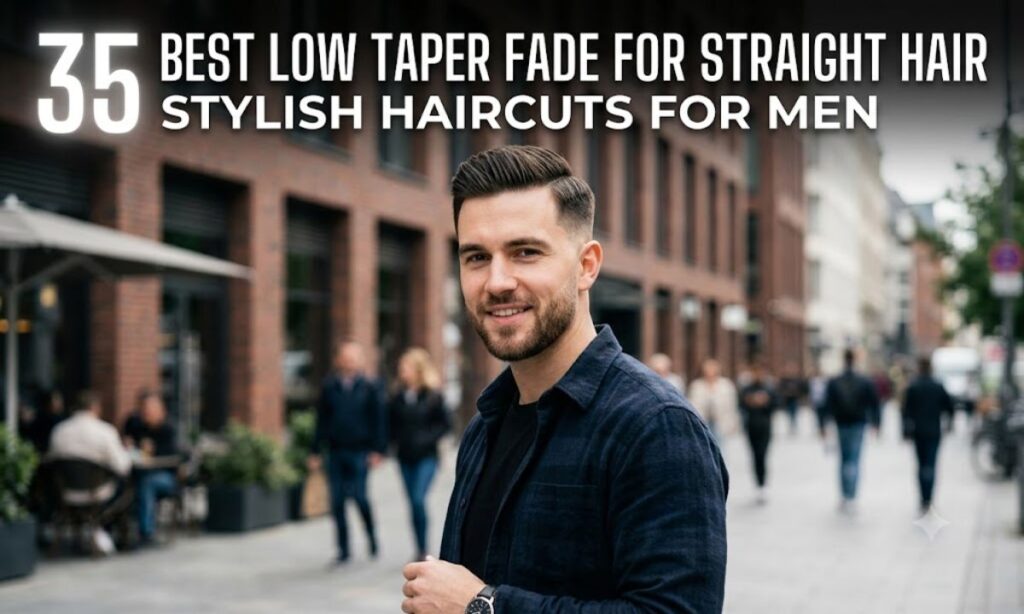
Straight hair and a low taper fade might be the easiest style combo a man can ask for. The sides stay neat, the top keeps its natural flow, and the whole look barely needs any effort to maintain.
That’s probably why this cut keeps showing up on barbershop request lists year after year.
If you’ve got straight hair and you’re tired of styles that fight against your hair’s natural texture, this guide breaks down exactly why the low taper fade works so well, how the cutting technique actually functions, and 35 of the best variations to bring to your next barber appointment.
Why Straight Hair and Low Taper Fades Are a Perfect Match

Straight hair behaves predictably. It lies flat, catches light evenly, and doesn’t fight the comb the way wavy or curly hair sometimes does. That predictability is exactly what makes a low taper fade look so sharp on straight strands.
Natural Contrast and Definition
Because straight hair sits close to the scalp, the gradual blend of a low taper — from skin-short at the neckline to longer length on top — shows up as a crisp, visible line. There’s no frizz or curl pattern breaking up the transition, so the fade reads as clean and intentional from every angle.
Professional Versatility
A low taper fade sits just above the ears and along the neckline, which keeps it subtle enough for office environments, interviews, and formal events. It’s polished without looking like it’s trying too hard — a big reason barbers recommend it to clients who need one haircut that works everywhere.
Low Maintenance Requirements
Compared to a high or skin fade, the low taper grows out far more gracefully. Straight hair holds its shape between cuts, so you can typically stretch appointments to every 3–4 weeks without the style looking uneven or patchy.
Understanding the Technical Aspects

Before picking a style, it helps to know what actually happens during the cut.
Precise Cutting Techniques
A low taper fade is built in stages:
- Neckline and sideburns are trimmed shortest, often with a #1 or #0.5 guard.
- Blend zone above the ears gradually increases in guard length, creating the graduated fade effect.
- Top length is left longer and shaped separately, depending on the style — textured, slicked, side-parted, or brushed back.
Because straight hair doesn’t shrink or coil, barbers can cut with more precision, and the finished blend tends to look sharper immediately after the appointment.
| Fade Zone | Typical Guard Length | Purpose |
| Neckline | Skin to #0.5 | Sharp, clean base |
| Blend area (above ears) | #1 to #3 | Smooth graduation |
| Top | Scissor cut / longer clipper guard | Styling flexibility |
Low Taper Fade
35 Best Low Taper Fade Styles for Straight Hair

Here are the top styles worth showing your barber, grouped by category for easier browsing.
Textured and Modern Styles
- Low Taper Fade with Textured Top Straight Hair – Choppy, layered texture on top paired with a subtle fade for a lived-in, modern finish.
- Textured Crop – Short, blunt fringe with heavy texture; a low-maintenance favorite.
- Textured Fringe Low Taper – Combines a soft fringe with clean tapered sides.
- French Crop with Low Taper – Choppy top layers with a straight-across fringe.
- Textured Quiff – Volume at the front, taper blending into the crown.
Classic and Professional Cuts
- Classic Side Part – Timeless, business-appropriate, and easy to maintain.
- Slick Back Low Taper – Combed-back top with a polished, refined finish.
- Low Taper Fade Back – Emphasizes a clean, sharp neckline for a formal look.
- Ivy League Cut – Slightly longer top styled to the side, a preppy staple.
- Businessman’s Comb Over – Structured part with a soft taper underneath.
Short Hair Low Taper Fade Styles
- Short Hair Low Taper Fade – Minimal length on top, maximum ease of styling.
- Buzz Cut with Low Taper – Uniform short length blended into a subtle fade.
- Crew Cut Taper – Slightly longer at the front, tapering down the back.
- Caesar Cut with Low Taper – Short, horizontal fringe with tapered sides.
- Low Taper Fade Fringe – Straight-cut fringe sitting just above the brow.
Pompadour and Volume-Based Styles
- Classic Pompadour – Height at the front, tapered sides for contrast.
- Modern Pompadour Fade – Slightly softer volume with a low, subtle blend.
- Side-Swept Pompadour – Volume swept to one side for an editorial look.
- Textured Pompadour – Matte finish with a piecey, tousled top.
Edgy and Creative Options
- Taper Fade with Hard Part – A shaved line separating the fade from the top style.
- Zig-Zag Design Taper – A shaved pattern above the nape for extra flair.
- Spiky Fringe Taper – Gravity-defying front section with a low blend beneath.
- Two-Tone Taper Fade – Subtle highlights paired with a low fade for contrast.
- Faux Hawk Taper – Raised center strip with tapered sides.
Everyday Low-Maintenance Cuts
- Brushed-Up Taper – Simple upward brush with natural texture.
- Middle Part Taper – Center-parted top with a soft, low fade.
- Wavy-Look Taper (styled with product for texture) – Works even on naturally straight hair with the right cream.
- Undercut with Low Taper Blend – Slightly disconnected look with a smooth base.
- Low Taper Fade with Beard – Facial hair pairing that frames the jawline.
Special Occasion and Trend-Forward Styles
- Low Taper Fringe with Design – Fringe paired with a subtle shaved detail.
- Glossy Slick Back – Wet-look finish for events and formal settings.
- High-Volume Textured Top – Bold height contrasted with a discreet fade.
- Low Taper with Curtain Fringe – Center-parted fringe framing both sides of the face.
- Salt-and-Pepper Taper – Natural gray blended with a clean low fade for mature men.
- Platinum-Tipped Taper – Subtle color contrast on top with a classic low blend.
How to Choose the Right Style for You

| Consideration | What to Ask Your Barber |
| Face shape | Round faces suit height on top; square faces suit softer, textured tops |
| Lifestyle | Office jobs favor classic side parts; casual settings suit textured crops |
| Hair density | Thicker hair handles pompadours well; finer hair suits shorter crops |
| Maintenance time | Buzz cuts and crew cuts need the least daily styling |
Styling and Maintenance Tips
- Use a lightweight matte cream for textured looks to avoid greasy shine.
- Apply pomade sparingly for slick-back styles to keep hold without stiffness.
- Book touch-ups every 3–4 weeks to keep the fade line crisp.
- Ask your barber to blend rather than sharply cut the neckline for a softer regrowth phase.
- Blow-dry damp hair in the direction you want it styled before applying product.
35 Best Low Taper Fade for Straight Hair Female: Stylish Cuts for Women (2026)

The low taper fade isn’t just a men’s barbershop staple anymore. More women with straight hair are asking for it because it delivers a clean, defined shape at the neckline and sides while leaving plenty of length on top to style however they like.
If you have straight hair and want a haircut that looks sharp on day one and still looks good on day twenty, the low taper fade is worth a serious look. This guide walks through why it works so well for straight hair, the best styling options, and how to keep it looking fresh between salon visits.
Hair Structure Considerations
Straight hair reflects light evenly and lies flat against the scalp, which is exactly why a low taper fade looks so crisp on this hair type.
- No curl pattern to disrupt the line – the fade transition stays visible and sharp.
- Fine to medium straight hair blends smoothly with almost no extra thinning needed.
- Thick straight hair may need slight thinning at the crown so the top doesn’t sit too heavy over the fade.
- Hair density affects how long the top section should be left for styling flexibility.
Because straight strands don’t spring back after cutting, stylists can measure the fade with more precision, which is one reason this cut has become a favorite among women looking for structured, low-maintenance styles.
Mid Taper Fade vs. Low Taper Fade

Before booking an appointment, it helps to know exactly where you want the fade to sit.
| Feature | Low Taper Fade | Mid Taper Fade |
| Starting point | Just above the ears | Above the temple/mid-head |
| Visibility | Subtle, less noticeable | More noticeable, bolder statement |
| Best for | Professional settings, first-time fade wearers | Fashion-forward looks, more edge |
| Maintenance | Every 3–4 weeks | Every 2–3 weeks |
| Styling flexibility | High — works with long or short tops | High, but shorter sides limit some styles |
A low taper fade is generally the safer, more versatile choice, while a mid taper fade makes more of a statement if you want something bolder.
Popular Styling Options for Low Taper Fade with Straight Hair
Here are 35 of the most requested variations, grouped for easier browsing.
Sleek and Professional Looks
- Classic side part with low taper fade
- Slicked-back low taper
- Straight-across bob with tapered nape
- Low taper lob (long bob)
- Sleek center-part with tapered sides
Pixie and Short Cut Variations
- Taper fade pixie cut
- Textured pixie with low fade
- Asymmetric pixie taper
- Side-swept pixie with tapered sides
- Cropped pixie with soft fade blend
Bold and Edgy Styles
- Undercut with tapered fade
- Fade mullet for straight hair
- Low taper faux hawk
- Shaved-side low taper with long top
- Low taper fade with geometric shave design
Long Hair with Tapered Sides
- Low taper fade with long layered top
- Straight hair low taper with curtain fringe
- Long top brushed back over low fade
- Low taper with center-parted length
- Low taper with side-swept long fringe
French Crop and Fringe Styles
- French crop with low taper fade
- Blunt fringe with tapered nape
- Soft fringe low taper
- Textured fringe with subtle fade
- Wispy fringe low taper
Color-Enhanced Styles
- Two-tone low taper fade
- Balayage top with tapered sides
- Platinum blonde low taper
- Money-piece highlights with low fade
- Dark root, light top low taper
Textured and Volume-Based Styles
- Spiky top with low taper fade
- Textured quiff with tapered sides
- Voluminous crown with low fade base
- Wavy-look styled top on straight hair
- Piecey layered top with low taper
Professional Styling Products and Techniques

Getting the finish right depends heavily on product choice.
| Product Type | Best For | Finish |
| Matte clay | Textured, piecey styles | Natural, no shine |
| Pomade | Slick-back and side-part styles | Glossy, defined hold |
| Light styling gel | Fringe and quiff shaping | Medium hold, some shine |
| Volumizing mousse | Adding lift at the crown | Soft, natural body |
| Smoothing serum | Sleek, straight finishes | High shine, frizz control |
Application Techniques
- Apply product to towel-dried, not soaking wet, hair for better control.
- Work product through mid-lengths first, then the roots, to avoid greasy buildup near the scalp.
- Use a fine-tooth comb for sleek styles and fingers for textured, piecey looks.
- Blow-dry with a round brush if you want volume at the crown before applying product.
- Finish with a light-hold hairspray to lock the style in place without stiffness.
Maintenance and Upkeep Strategies

A low taper fade needs regular attention to stay sharp, even though it’s considered low-maintenance overall.
- Trim schedule: Book a touch-up every 3–4 weeks to keep the fade line clean.
- Home upkeep: Use clippers with a guard to lightly maintain the neckline between salon visits, if comfortable doing so.
- Product buildup: Wash with a clarifying shampoo weekly if using pomade or gel daily.
- Heat protection: Use a heat protectant spray before blow-drying or straightening the top section.
- Growing it out: Ask your stylist to blend the taper into a longer style gradually rather than letting it grow out unevenly.
Face Shape Compatibility
Choosing the right variation for your face shape makes a noticeable difference in how flattering the cut looks.
| Face Shape | Recommended Style | Why It Works |
| Round | Taper with height on top (quiff, pompadour) | Adds length, reduces width |
| Square | Softer, textured top with subtle fade | Balances strong jawline |
| Oval | Almost any style works | Naturally balanced proportions |
| Heart | Side-swept fringe with low taper | Softens a narrower chin |
| Long | Fringe-forward styles with low taper | Shortens visual face length |
Straight Hair
Common Mistakes and How to Avoid Them
- Going too short on top – leaves little room to change up styling later; ask for extra length if you’re unsure.
- Skipping touch-up appointments – lets the fade grow out unevenly and look patchy.
- Using too much heavy product – weighs down straight hair and can look greasy by midday.
- Choosing a fade height without face-shape guidance – always ask your stylist for input based on your bone structure.
- Not communicating maintenance habits – tell your stylist how often you’re willing to get trims so they can pick a length that grows out well.
Low Taper Fade for Straight Hair: Advanced Variations, Trends & Expert Barber Tips (2026)
Once you’ve nailed the basics of a low taper fade, the next step is knowing which advanced variations actually work with straight hair — and which ones just look good in photos but fall apart within a week.
Straight hair has one big advantage here: it holds a fade line cleanly and doesn’t fight structured styling. That makes it a great canvas for bolder cuts like the low taper mullet, temple fade, disconnected taper, and blowout. Below, we break down each trend, plus the seasonal and styling details barbers rarely explain in full.
Advanced Variations and Trends
The classic low taper fade is a safe, reliable base. These variations build on that foundation with more personality, more texture, or a sharper edge.
Low Taper Fade Mullet
The low taper fade mullet keeps the sides and back cut close near the hairline, then gradually lengthens as it climbs — hairmora but leaves noticeably more length at the back and top than a standard taper.
- Works best on medium-length straight hair that sits between a classic mullet and a shag.
- Straight strands lie flat, so a bit of layering or texturizing spray helps prevent the back section from looking stringy.
- Pairs well with a fringe at the front for a more balanced silhouette.
- Best suited to men who want a low-maintenance base with a statement-making length in the back.
Temple Fade Variation
A temple fade keeps the low taper at the neckline but adds a subtle shaped taper around the temples too.
- Adds visible definition when viewed from the front, without going full mid-fade.
- Works especially well for straight hair since the temple area shows a crisp, sharp line.
- A good middle-ground option if you want more contrast than a basic low taper but aren’t ready for a bolder fade height.
Disconnected Low Taper
The disconnected low taper creates a deliberate contrast between the length on top and the closely faded sides, rather than a smooth, gradual blend.
- Straight hair on top appears fuller and more distinct against the shorter sides.
- Common styling options include a textured crop, quiff, or slicked-back top.
- Barbers typically use a hard part or slight gap between sections to make the disconnection obvious.
- Best for men who want a bolder, more editorial look than a traditional blended fade.
Blowout Styling
A blowout combines a low taper fade with extra volume and lift through the top, usually achieved with a round brush and blow dryer.
- Straight hair takes to blowout styling well because it doesn’t need extra product to hold shape once dried.
- Creates a fuller, rounder silhouette compared to a flat, combed-down top.
- Works especially well for thicker straight hair that can support the added volume.
- Typically finished with a light hold spray to keep the shape without stiffness.
Comparing the Advanced Variations
| Style | Best Hair Density | Visual Impact | Maintenance Frequency |
| Low Taper Mullet | Medium to thick | Bold, statement-making | Every 3–4 weeks |
| Temple Fade | Any density | Subtle but sharp | Every 2–3 weeks |
| Disconnected Low Taper | Medium to thick | High contrast | Every 3 weeks |
| Blowout | Medium to thick | Voluminous, rounded | Every 3–4 weeks |
Expert Tips from Professional Barbers
Barbers who specialize in taper fades tend to repeat the same handful of pieces of advice, regardless of which variation a client chooses:
- Bring a reference photo, but expect some adjustment — every head shape and hair density blends slightly differently.
- Ask for the fade to be blended, not lined, if you want it to grow out gracefully between appointments.
- Request a #1 or #1.5 guard at the lowest point of the fade for a softer transition than a skin fade.
- Get color and cutting done separately if you’re adding highlights or a two-tone look — cutting first can distort how color settles.
- Book your next appointment before you leave — taper fades that go too long between trims lose their clean shape fastest of all fade styles.
Seasonal Considerations
Straight hair and a low taper fade respond differently depending on the time of year.
- Summer: Sweat and humidity can make styled tops look flat by midday. A lightweight matte product holds shape without adding grease.
- Winter: Dry indoor heat can leave straight hair prone to static. A small amount of smoothing serum helps control flyaways.
- Spring/Fall: Transitional weather is the easiest season for styling — most products perform consistently without extra adjustments.
- Special occasions: For events, a glossy pomade or wet-look finish photographs better than a matte product under bright lighting.
| Season | Recommended Product | Why |
| Summer | Matte clay | Controls oil, avoids heaviness |
| Winter | Smoothing serum | Reduces static and flyaways |
| Spring/Fall | Light styling cream | Reliable hold in mild conditions |
| Events | Pomade or wax | Glossy finish, photographs well |
Does a Low Taper Fade Look Good on Straight Hair?
Yes — straight hair is actually one of the best textures for a low taper fade. Because the strands lie flat and reflect light evenly, the transition between the faded sides and the longer top reads as a clean, sharp line rather than a blurred gradient. Curly or coily hair can still pull off a great fade, but the contrast tends to look softer since the curl pattern breaks up the blend.
Straight hair also holds product predictably, which means styles like a blowout, disconnected top, or slicked-back finish look consistent from morning to evening without much touch-up.
Conclusion
A low taper fade is one of the best choices for straight hair. It looks clean and sharp right away. It also grows out without looking messy.
You don’t need a bold style to look good. A classic side part works for daily life. A textured crop adds a bit more flair.
Pick a style that fits your routine. Talk to your barber about your face shape. Then enjoy a haircut that’s easy to keep sharp.
Frequently Asked Questions
Is a low taper fade good for straight hair?
Yes. Straight hair shows the fade line clean and sharp, making it one of the best textures for this cut.
What is a low taper fade haircut?
It’s a haircut where the sides fade short near the ears and neckline, while the top stays longer.
How often should I get a low taper fade?
Every 3 to 4 weeks keeps the fade looking fresh and clean.
Does a low taper fade suit thin hair?
Yes. Shorter styles like buzz cuts or crew cuts work great with thin straight hair.
What’s the best haircut for straight hair men?
A low taper fade is one of the top picks because it’s sharp, easy to style, and low maintenance.
Can I style a low taper fade without gel?
Yes. Simple cuts like a buzz cut or crew cut don’t need any product.
Is a low taper fade professional for work?
Yes. It’s subtle, neat, and works well in office and formal settings.
