
Picking the right haircut can feel harder than it should be. Walk into any barbershop and you’ll hear names like “taper,” “quiff,” or “Caesar cut” thrown around like everyone should already know the difference.
If you’ve ever nodded along without really knowing what you were agreeing to, this guide is for you.
Below, we’ve broken down the most popular types of men’s haircuts by length, texture, and style — from buzz cuts to bold mohawks — so you can walk in confident and walk out with exactly the look you wanted.
How to Choose the Right Haircut

Before jumping into the list, it helps to know what actually determines whether a haircut will suit you:
- Face shape – Oval, round, square, and long faces all pair better with different cuts.
- Hair texture – Straight, wavy, curly, and coily hair each hold certain styles differently.
- Lifestyle – A low-maintenance job or active routine may call for a shorter, wash-and-go style.
- Hair density – Thick hair supports volume-heavy looks; fine hair often looks best kept short.
- Maintenance commitment – Some cuts need a barber visit every two weeks; others can go two months.
Keep these five factors in mind as you scroll — they’ll help you narrow down which of these men’s haircuts is genuinely right for you, not just trendy.
Types of Men’s Haircuts
Quick Navigation
- Types of Haircuts for Men (Short Styles)
- Faded and Tapered Styles
- Textured and Longer Styles
- Classic and Business-Ready Cuts
- Comparison Table
- Frequently Asked Questions
Types of Haircuts for Men

There are more than 35 recognized types of men’s haircuts, and most modern looks are variations or combinations of the classics below. Let’s start with the short styles, since they’re the most requested at barbershops today.
Types of Men’s Haircuts: Short
Short haircuts are practical, low-maintenance, and suit almost every face shape. They’re also the easiest entry point if you’re switching from longer hair.
Buzz Cut

The buzz cut is about as simple as haircuts get — hair is clipped to a uniform, short length all over using clippers, usually a size 2 to 4 guard. It requires almost no daily styling, grows out evenly, and works well for men who want a clean, no-fuss look or are dealing with thinning hair.
Crew Cut

A step up from the buzz cut, the crew cut keeps the top slightly longer while tapering the sides and back short. It’s a military-inspired classic that’s easy to maintain and pairs well with round or square face shapes.
Ivy League

Sometimes called the “longer crew cut,” the Ivy League leaves more length on top so it can be combed to one side or pushed back. It’s a preppy, polished option that works in both casual and professional settings.
Caesar Cut

Named after Julius Caesar, this cut features short, horizontally cropped hair with a straight, textured fringe brushed forward. It’s simple to maintain and suits men with straight or slightly wavy hair.
Pompadour

The pompadour is a statement style: hair is swept upward and back from the forehead, creating noticeable volume and height. It needs a strong-hold pomade and some blow-drying skill, but the payoff is a bold, confident look.
Quiff

A more relaxed cousin of the pompadour, the quiff pushes hair upward and slightly back without the same rigid structure. It’s versatile enough to dress up or down and works with short-to-medium hair lengths.
Comb Over

The comb over involves growing the hair longer on one side and combing it across the top, usually paired with a fade or taper on the sides. It’s a timeless, professional-friendly style that suits thinning hair too.
Mohawk

A bolder choice, the mohawk keeps a strip of longer hair down the center of the head while the sides are shaved or buzzed very short. It’s a high-commitment, high-impact style best suited for men who want to stand out.
Faux Hawk

The faux hawk mimics the mohawk’s silhouette without shaving the sides completely — instead, the sides are simply cut shorter than the center strip. It offers the same edgy look with far less daily maintenance and no shaving upkeep.
The Taper Haircut

The taper haircut gradually shortens hair from top to bottom without exposing the scalp, unlike a fade. It’s one of the most requested finishing techniques and can be added to almost any haircut on this list — buzz cuts, crew cuts, and pompadours all look sharper with a clean taper.
Side Part

The side part is a classic, business-appropriate style where hair is combed to one side with a defined line, often created using a comb and light-hold product. It works particularly well on straight or wavy hair and pairs nicely with a mid or low fade.
Faded and Tapered Styles

Fades have become the most searched haircut style of the last decade, and for good reason — they’re customizable, modern, and flattering on virtually every face shape.
- Low fade – Fading begins just above the ears, offering a subtle transition.
- Mid fade – Fading starts around the temple area, striking a balance between bold and conservative.
- High fade – Fading begins higher on the head for maximum contrast between the top and sides.
- Skin (bald) fade – Hair fades all the way down to bare skin for the sharpest possible line.
- Burst fade – Fading curves around the ear rather than running in a straight line, often paired with longer top styles.
- Drop fade – The fade line curves downward behind the ear, adding a rounded, athletic silhouette.
Textured and Longer Styles
If shorter cuts aren’t your thing, these options give you more length to work with while still looking deliberate and groomed.
- Undercut – Long hair on top with closely shaved or buzzed sides for maximum contrast.
- Slicked back – Hair is combed straight back using pomade or gel for a polished, formal finish.
- Textured crop – Choppy, uneven layers on top paired with shorter sides for a French-inspired, low-effort look.
- French crop – A textured fringe with tapered or faded sides, popular for its versatility.
- Man bun – Longer hair gathered and tied at the crown or back of the head.
- Top knot – Similar to a man bun but styled higher and tighter for a sleeker finish.
- Man braid – Longer hair styled into one or more braids, often combined with shaved or faded sides.
- Curly shag – Layered cutting technique that enhances natural curl pattern and adds movement.
- Dreadlocks – Matted or braided rope-like strands, requiring a longer-term styling commitment.
Classic and Business-Ready Cuts

For workplaces with a conservative dress code, these cuts strike the right balance of neat and stylish.
- High and tight – An extreme version of the crew cut with very short sides and a slightly longer top.
- Gentleman’s cut – A refined, classic short style with a natural side part and minimal texture.
- Regulation cut – Military-standard short hair, uniform in length throughout.
- Executive cut – A polished, professional take on the side part with subtle fading.
Comparison Table: Popular Men’s Haircuts at a Glance
| Haircut | Maintenance Level | Best Hair Type | Styling Time |
| Buzz Cut | Very Low | All types | Under 1 minute |
| Crew Cut | Low | Straight, Wavy | 2–3 minutes |
| Pompadour | High | Straight, Wavy | 8–10 minutes |
| Quiff | Medium | Straight, Wavy | 5 minutes |
| Undercut | Medium | All types | 5–7 minutes |
| Skin Fade | High (frequent touch-ups) | All types | 2–5 minutes |
| Man Bun | Low | Straight, Wavy, Curly | 2 minutes |
| Textured Crop | Medium | Wavy, Curly | 5 minutes |
This table gives you a quick snapshot of which cuts demand daily attention and which ones you can style in seconds — useful if your morning routine is already tight.
How Often Should You Get a Haircut?

As a general rule:
- Short cuts (buzz cut, crew cut, high and tight) — every 2–3 weeks.
- Medium-length styles (quiff, pompadour, textured crop) — every 4–6 weeks.
- Longer styles (man bun, curly shag, dreadlocks) — every 6–8 weeks or longer.
Sticking to a consistent schedule keeps fades sharp and prevents shape loss in longer styles.
Choosing a Haircut for Your Face Shape
- Oval face – Almost any style works; quiffs and side parts are especially flattering.
- Round face – Choose cuts that add height, like a pompadour or textured crop, and avoid excess width on the sides.
- Square face – Softer, textured styles help balance strong jawlines.
- Long face – Styles that add width, such as a side-swept fringe, help create proportion.
Types of Fade Haircut Styles
Low Fade

A low fade begins roughly an inch above the ear, keeping most of the length on the sides while fading only near the hairline and neckline. It’s the most subtle version of the fade family, making it ideal for workplaces with conservative dress codes or anyone easing into the style for the first time. Because less hair is removed overall, a low fade also tends to grow out more gracefully between cuts.
Mid Fade

The mid fade starts around the temple, roughly halfway up the side of the head. It strikes a balance between understated and eye-catching, which is why barbers often recommend it as a safe, everyday choice. A mid fade works with almost any top style — think messy crops, pompadours, or a classic side part — and flatters most face shapes without overwhelming them.
High Fade

A high fade begins near or above the temple, creating a bold, high-contrast look between the very short sides and the longer top. This version is best suited to men who want their hairstyle to make a statement. High fades pair especially well with textured tops, faux hawks, and slick-backs, but they do grow out faster than lower fades and typically need a touch-up every two to three weeks.
Style for Every Look
Skin Fade

Also known as a bald fade, the skin fade blends hair all the way down to bare skin rather than stopping at a short guard length. It can be applied at low, mid, or high placement, giving you the sharpest, cleanest possible contrast against the top. Skin fades work across all hair types but require the most frequent maintenance of any fade style to keep the line crisp.
Drop Fade

A drop fade curves downward behind the ear instead of running in a straight horizontal line, following the natural shape of the skull. This creates a rounder, more athletic silhouette and works especially well for men with thick or curly hair who want extra shape control on the sides.
Burst Fade

The burst fade curves in a semicircle around the ear rather than continuing along the nape of the neck. It’s a popular choice for styles like the mullet or textured crop, since it leaves more length at the back while still delivering a sharp fade around the ear.
Taper Fade

A taper fade keeps more length throughout the sides and back, fading to skin only at the temples and nape of the neck. It’s a softer, more traditional take on the fade family and remains one of the most requested options for professional settings.
Fade Comparison Table
| Fade Type | Starting Point | Contrast Level | Best For | Touch-Up Frequency |
| Low Fade | ~1 inch above ear | Subtle | Conservative workplaces, beginners | Every 3–4 weeks |
| Mid Fade | Mid-temple | Balanced | Almost any face shape or style | Every 2–3 weeks |
| High Fade | Near/above temple | Bold | Statement looks, textured tops | Every 2 weeks |
| Skin Fade | Low, mid, or high | Sharpest | Clean, modern finish | Every 1–2 weeks |
| Drop Fade | Curves behind ear | Moderate to bold | Curly or thick hair | Every 2–3 weeks |
| Burst Fade | Around the ear only | Bold, localized | Mullets, textured crops | Every 2–3 weeks |
Hair Length Guide

Fades aren’t just about the sides — the length you keep on top changes the entire look.
- Short (under 1 inch): Pairs with buzz cuts and crew cuts for a low-maintenance, uniform finish.
- Medium (1–3 inches): Works well with textured crops, quiffs, and side parts, offering styling flexibility.
- Long (3+ inches): Suited to pompadours, slicked-back styles, and man buns, giving the fade a dramatic contrast against volume on top.
Types of Men’s Haircuts: Medium-Length
If you’re pairing a fade with medium-length hair on top, these are some of the most popular combinations:
- Textured Crop – Choppy, layered top cut for a naturally tousled finish.
- Quiff – Hair pushed upward and slightly back for a versatile everyday look.
- Side Part – A defined, combed part paired with a low or mid fade for polish.
- Curly Top Fade – Natural curls or waves left longer on top with faded sides.
- Comb Over Fade – Hair combed to one side, blending into a low or mid fade.
Choosing the Right Haircut for Your Face Shape & Lifestyle

Your face shape plays a major role in which fade will look most flattering:
- Round faces – A high fade adds height and helps elongate the face.
- Square faces – A mid fade softens strong jawlines without competing with them.
- Oval faces – Almost any fade works; this is the most versatile face shape.
- Long faces – A low fade keeps more width on the sides, balancing overall proportions.
Lifestyle matters too. If you’re in a corporate environment, a low or mid fade paired with a side part usually reads as more professional. If you have an active schedule or work in a creative field, a high or skin fade offers a bolder, lower-maintenance option day-to-day (even if it means more frequent barber visits).
Haircut Maintenance Guide

Keeping a fade sharp isn’t just about the initial cut — it’s about the routine afterward.
Schedule Smart
Book your next appointment before the fade line starts to blur. Low fades can typically wait three to four weeks, while high and skin fades look best refreshed every one to two weeks.
Hair Care Basics
Wash your hair two to three times a week with a shampoo suited to your hair type, and keep the scalp moisturized, especially if you’re wearing a skin fade where more scalp is exposed to the elements.
Product Know-How
The right product depends on your top style:
- Pomade – Best for slicked-back looks and defined side parts.
- Matte clay or paste – Ideal for textured crops and natural-looking volume.
- Sea salt spray – Great for adding texture to wavy or curly tops.
- Light-hold gel – Works well for quiffs that need flexible hold without stiffness.
Haircut Maintenance Tips from the Pros
- Always let your barber know your fade height using clear terms — low, mid, or high — rather than vague instructions like “shorter on the sides.”
- Bring a reference photo so there’s no guesswork on where the fade should begin.
- Book touch-ups before the line grows out completely; a slightly early trim keeps the shape sharper for longer.
- Moisturize your scalp regularly if you’re maintaining a skin fade, since more skin stays exposed to sun and dryness.
Types of Men’s Haircuts With Pictures
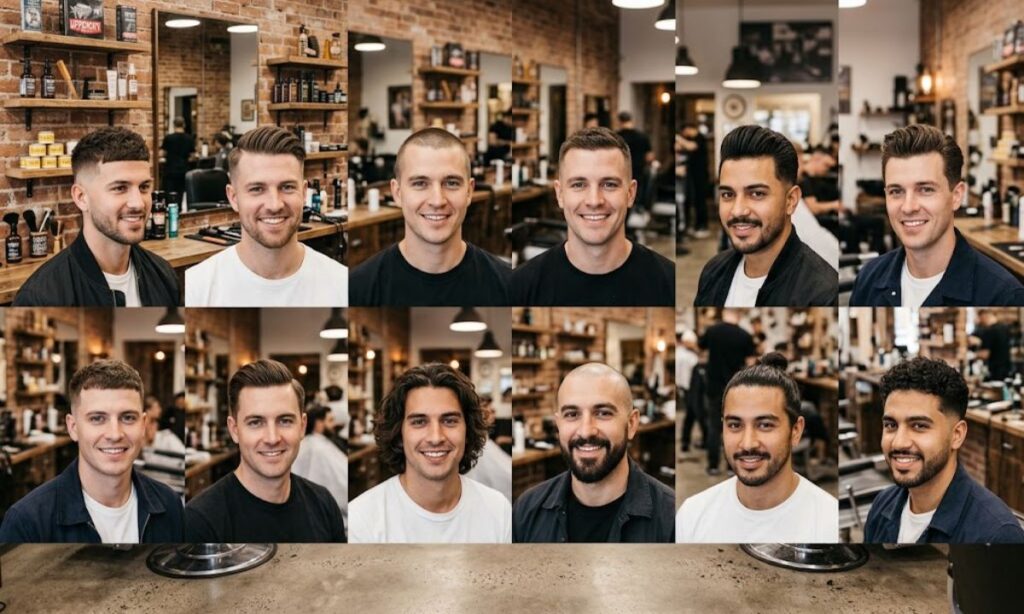
While this guide focuses on written descriptions, most barbershops and styling apps now offer visual look-books so you can compare a low fade against a high fade side by side before committing. Bringing a photo reference — even a rough one — remains the single most effective way to avoid miscommunication in the chair.
Frequently Asked Questions
What is the most popular men’s haircut right now?
The skin fade paired with a textured top is currently the most requested style at barbershops, thanks to its clean look and versatility.
What haircut should I get for a round face?
Go for cuts that add height, like a pompadour, quiff, or high fade, and avoid extra width on the sides.
How short is a buzz cut?
A buzz cut is clipped to a uniform length all over, usually between a size 2 and 4 guard (about 1/4 to 1/2 inch).
What’s the difference between a fade and a taper?
A fade blends hair down to bare skin, while a taper gradually shortens hair without fully exposing the scalp.
How often should men get a haircut?
Short styles need a trim every 2–3 weeks, medium-length cuts every 4–6 weeks, and longer styles every 6–8 weeks.
What haircut is best for thinning hair?
Buzz cuts, crew cuts, and comb overs work best since they minimize visible gaps and keep maintenance low.
What do I say to my barber for a good haircut?
Use specific terms like “low fade” or “textured crop,” and bring a reference photo so there’s no guesswork.
Conclusion
Choosing a haircut doesn’t have to be stressful. There are over 35 styles to pick from. Some are short and simple. Others take more time and care.
Your face shape matters. So does your hair type. A buzz cut works for some men. A pompadour suits others better. Think about your daily routine too.
Talk to your barber clearly. Bring a photo if you can. Use the right terms, like “low fade” or “textured crop.” This helps you get the exact look you want.
At the end of the day, the best haircut is the one that fits you. It should match your style and your life. Don’t be afraid to try something new. A great haircut can change how you feel every day.
